
pinax

pinax

pinaxPlayground for INspiring AI eXperiences)
Provenance-linked analysis weaves new insights, a creative playground for materials research

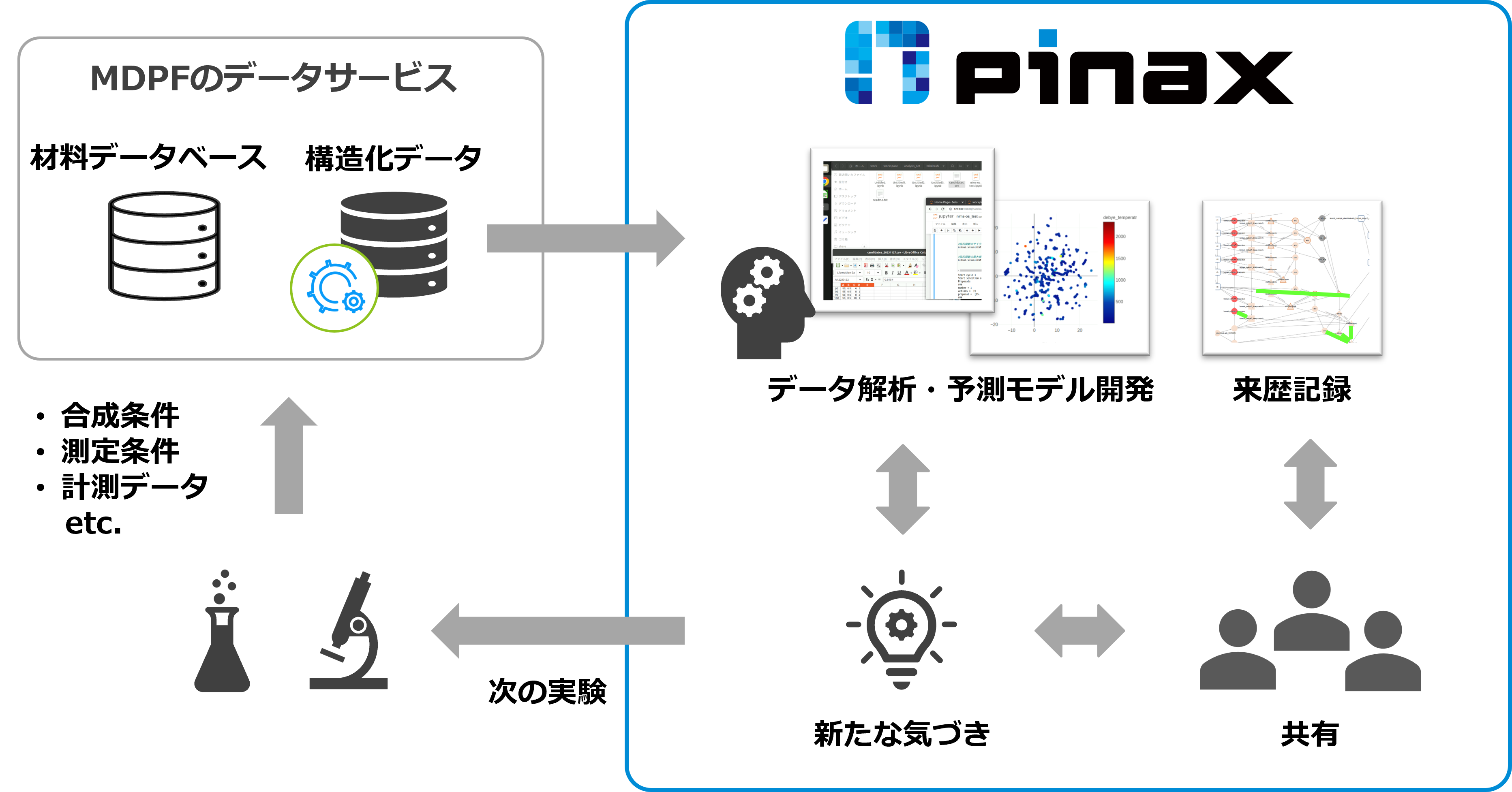
  • We provide a platform for "analysis, provenance recording, and sharing" that enables highly transparent utilization of machine-learning trials and outcomes.
  • This system records the model creation process--including material data, machine learning algorithms, models, and analysis results--ensuring the reproducibility of machine learning process.
  • It centrally organizes your model development and analysis processes into network graphs, accelerating data-driven research by generating new insights.

abstract_en.png

Go to the Pinax system (login page)

Learn More
  1. What You Can Do with pinax (Key Features)
  2. Use Cases
  3. How to Use pinax (Guides)
  4. Get Started with pinax (Application Procedures)
  5. System Requirements


What pinax Aims to Achieve

pinax is a system that accelerates research efficiency and knowledge creation by recording and managing the trial-and-error process and analysis steps of machine learning model development as "provenance," and sharing this provenance among users.While its primary users are advanced data scientists and research projects continuously refining numerous models, aspiring researchers can also utilize it as a platform for analyzing their own data.
Its key feature is recording and visualizing the model development process as a network graph (hereafter, "graph"), thereby enhancing the reproducibility of machine learning processes. In addition to inputs and outputs and parameter settings, it also links and preserves the "context" --such as hypotheses and reasons for choices, interpretations of evaluations, and runtime environments/dependencies.
pinax functions as: (1) a "knowledge creation space" supporting free trial and error, (2) a "data utilization space" integrated with NIMS material databases and MDPF data services, and (3) a "knowledge sharing space" promoting the sharing and reuse of analysis procedures and models. Tracing accumulated network graphs reveals procedures suitable for model derivation, convergence, and reuse, providing starting points for subsequent analyses.
As a result, it simplifies the management of model refinement processes and the integration of development information - tasks often difficult in individual environments - thereby accelerating knowledge sharing, streamlining research, expanding knowledge, and fostering collaboration. With pinax, be part of building the collective intelligence for data-driven materials research, starting with the recording of provenance and the sharing of context.


What you can do with pinax (Key features)

With pinax, everything from collecting and preprocessing materials data, to model development, evaluation of analysis results, and sharing of insights and procedures can be completed within a single environment.

Providing a Data Analysis Environment

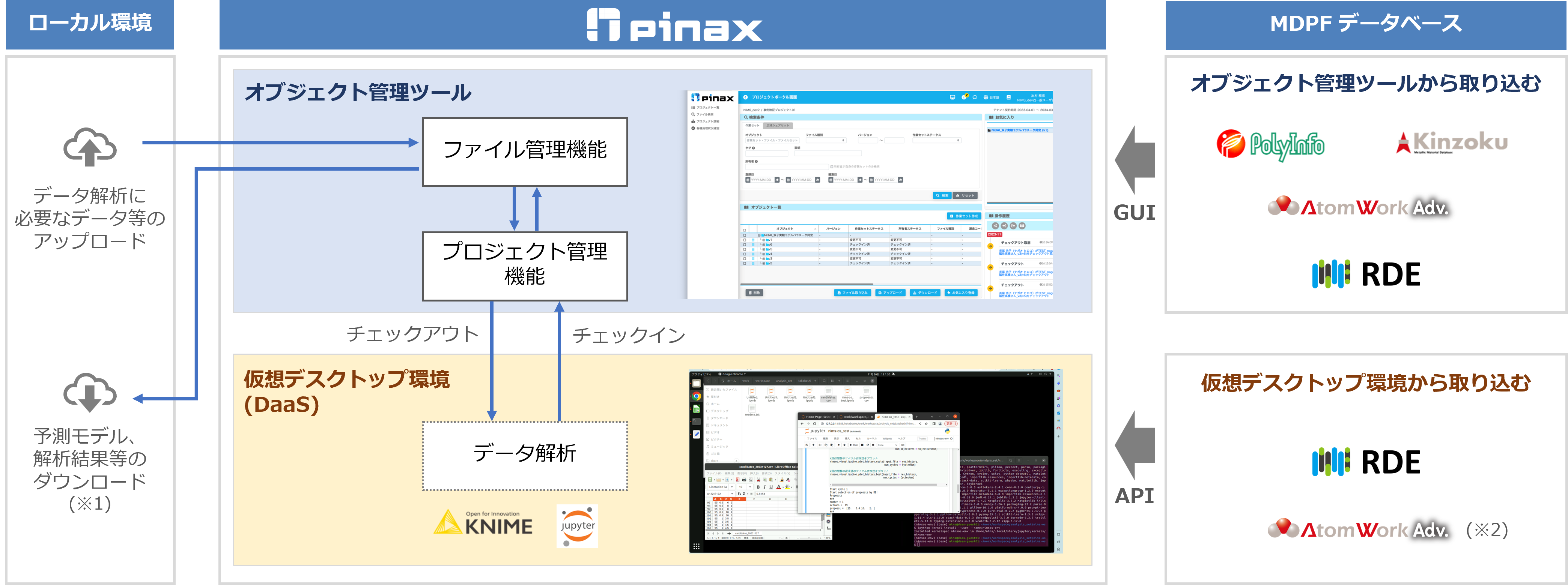
pinax offers a data object management tool and a cloud-based virtual desktop environment (DaaS: Desktop as a Service). Users access this analysis environment via a web browser, enabling them to develop models and analyze material data without needing to prepare computational resources or basic analysis libraries.

DaaS.png

*1. When using MDPF data, download restrictions apply.
*2. Data available to users with an API usage contract.


Integration with Material Databases

pinax integrates with the MDPF materials database, enabling the utilization of high-quality substance and material data for diverse data analysis through model development and reuse.


Recording the Trial-and-Error Process of Analysis

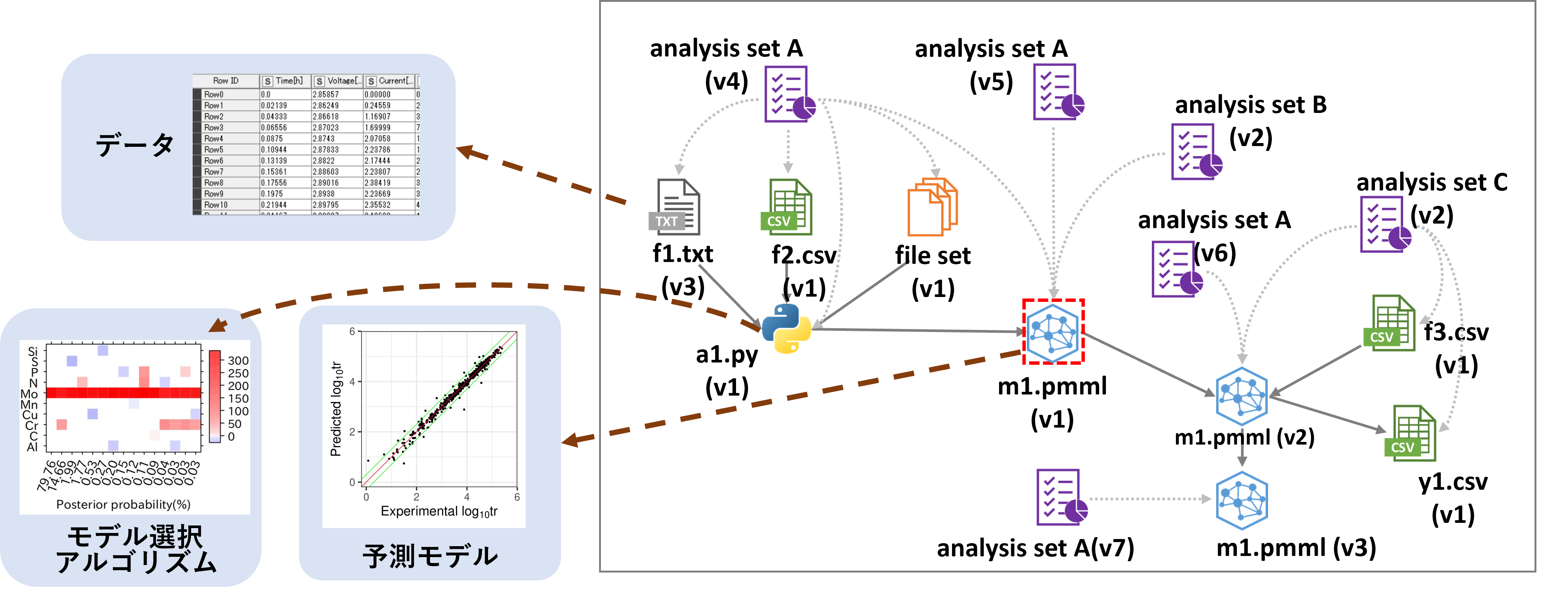
pinax records the file generation process in data analysis and model development as provenance, and can display the relationships between elements (nodes) such as data, models, and analysis results as a network graph represented by connections (edges).
Each node can be linked with detailed provenance information, including "who," "when," and "what data/algorithms/workflows" were used.
This enables third parties to intuitively trace the model construction process, ensuring transparency in the development workflow and reproducibility during execution.

provenance_en.png
Schematic Diagram of Model Provenance

Sharing and Reusing Analysis Procedures and Models

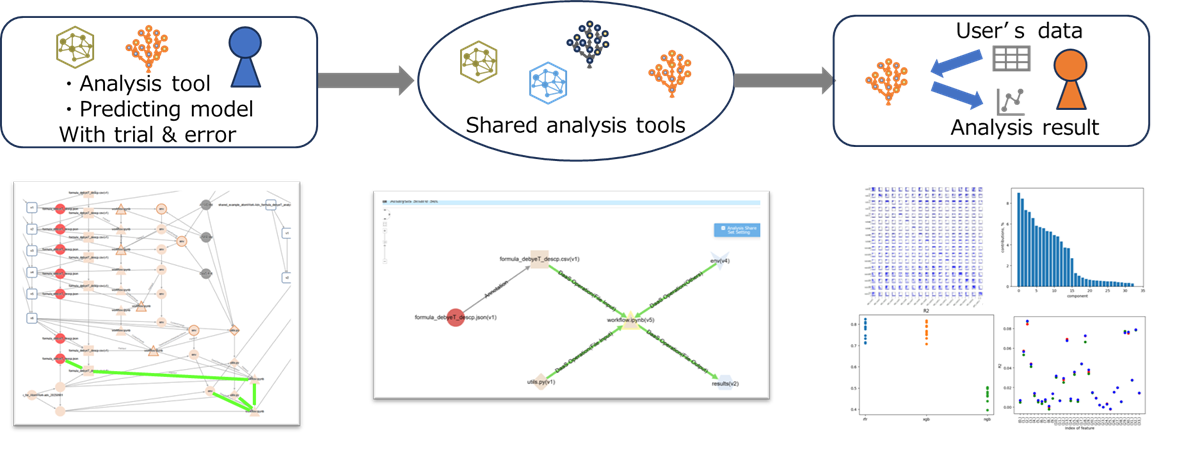
Datasets used for analysis, algorithms/workflows, models, and analysis results are centrally managed as "analysis-sets" for each unit of work. By setting the sharing scopes, researchers and teams can securely and efficiently share and reuse the provenance, promoting the horizontal deployment of insights from model development and utilization, as well as collaborative research.

share.png


(Under development) AI-driven recommendations

A recommendation feature is under development for pinax that will leverage network graph provenance to suggest suitable files for model development, preprocessing, and analysis. Furthermore, it assists in the improvement of development and operations by identifying and suggesting effective methods, models, and use cases from across the user community.


Leveraging these features enables more efficient model development and utilization, accelerating and enhancing the effectiveness of data-driven materials research.

Use Cases

Case 1: Predicting Materials Properties by Model Comparison (Provenance Management & Accuracy Comparison)

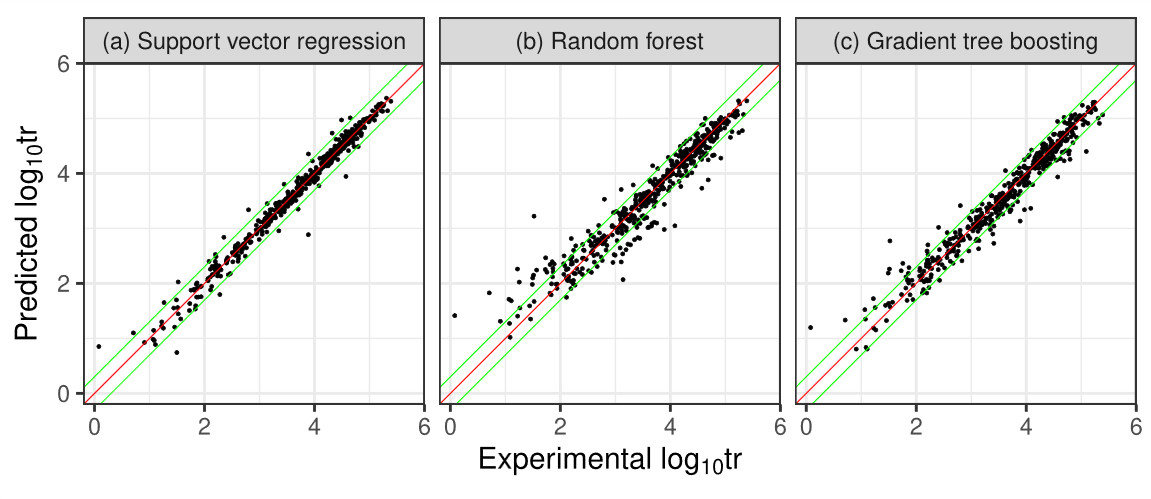
In this case study, we reproduced on pinax several methods used to predict the creep rupture life of heat-resistant steel [1]--namely, Support Vector Regression (SVR), Random Forest (RF), and Gradient Tree Boosting (GTB)--and evaluated the predictive performance of each model. As shown in Figure 1-1, the version of the analysis-set branches off midway. pinax records provenance such as data preprocessing, feature augmentation, and parameter tuning, and visualizes it as a network graph (Figure 1-2). This makes it possible to grasp at a glance the data sources, model-building workflows, relationships among models (black solid lines), and the origins of data files used to build models (green lines). By comparing these with performance evaluation results, you can identify effective procedures and improvement points. As a result, SVR showed predictions closest to actual measurements, while RF and GTB also demonstrated high performance (Figure 1-3).
[1] J. Sakurai, M. Demura, J. Inoue, and M. Yamazaki , Tetsu-to-Hagané Vol. 108 (2022), No. 7, pp.424
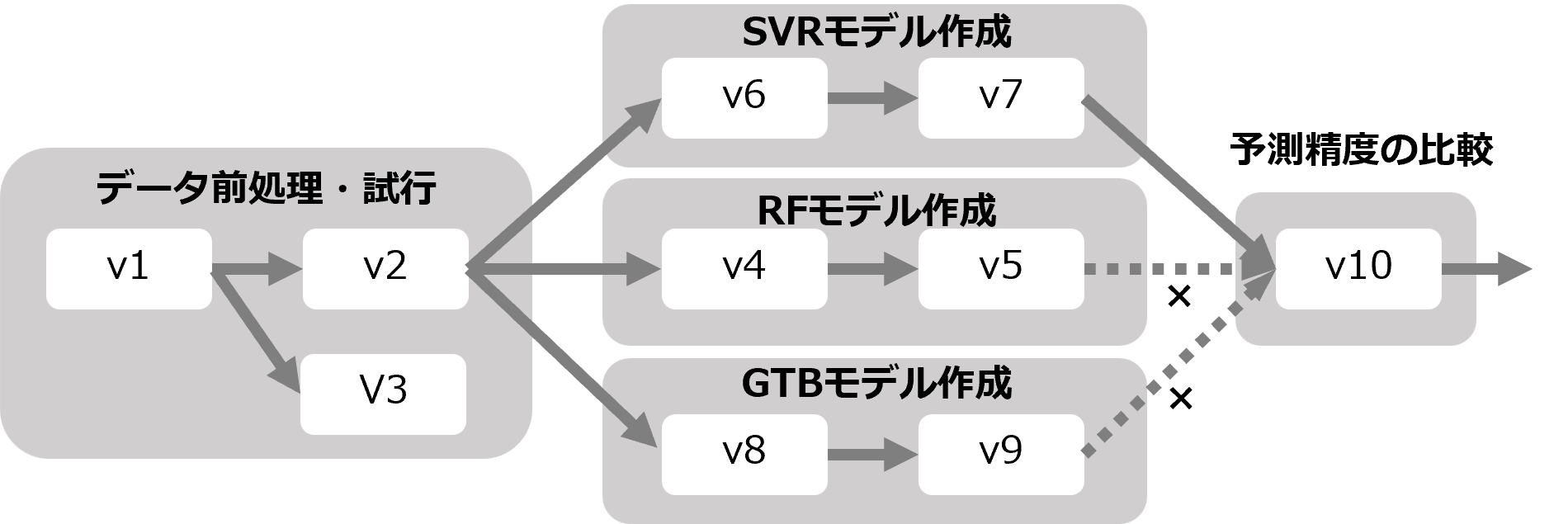
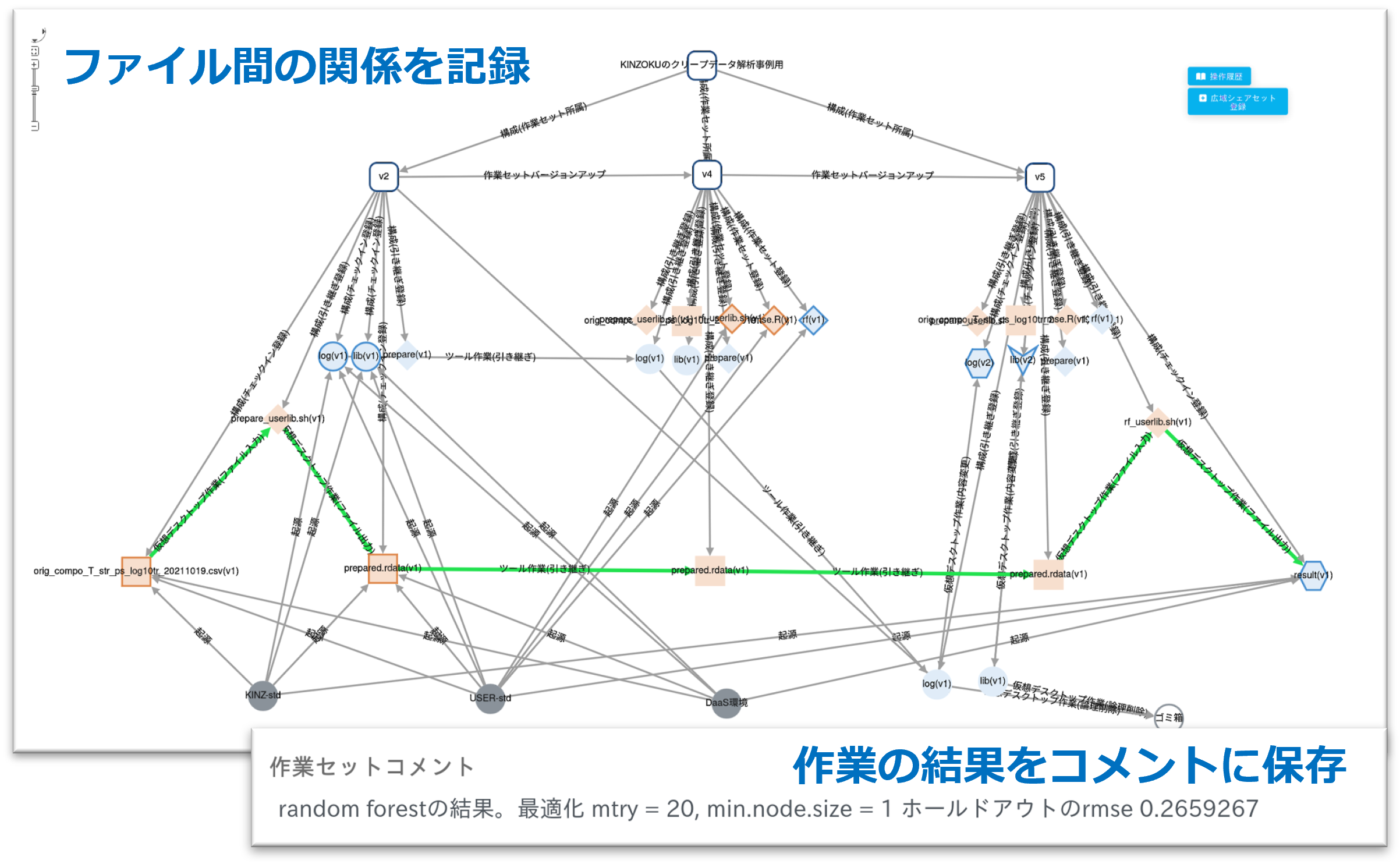
Figure 1-1. Relationships among analysis-set versions
   Figure 1-2. Visualization of analysis provenance
Figure 1-3. Evaluation of each model's predictive accuracy

Case 2: Unified Management and Utilization of Measurement Data via RDE Integration

Using research on improving the magnetic properties of Fe-Pt thin films as an example, we integrated TEM, VSM, and other measurement data stored in RDE (Research Data Express) within pinax, proposed optimal conditions with an experiment-point exploration library [2], and implemented a cycle of reflecting them in new experimental conditions (Figure 2). The flow of the process is indicated by the arrows in the figure. In addition to RDE data, we also utilized used data consisting of features and metadata obtained through structuring processes, completing a workflow centered on pinax that covers "collection & preprocessing → analysis → sharing."
[2] R. Tamura, K. Tsuda, and S. Matsuda, STAM-M, 3 (2023) pp.1
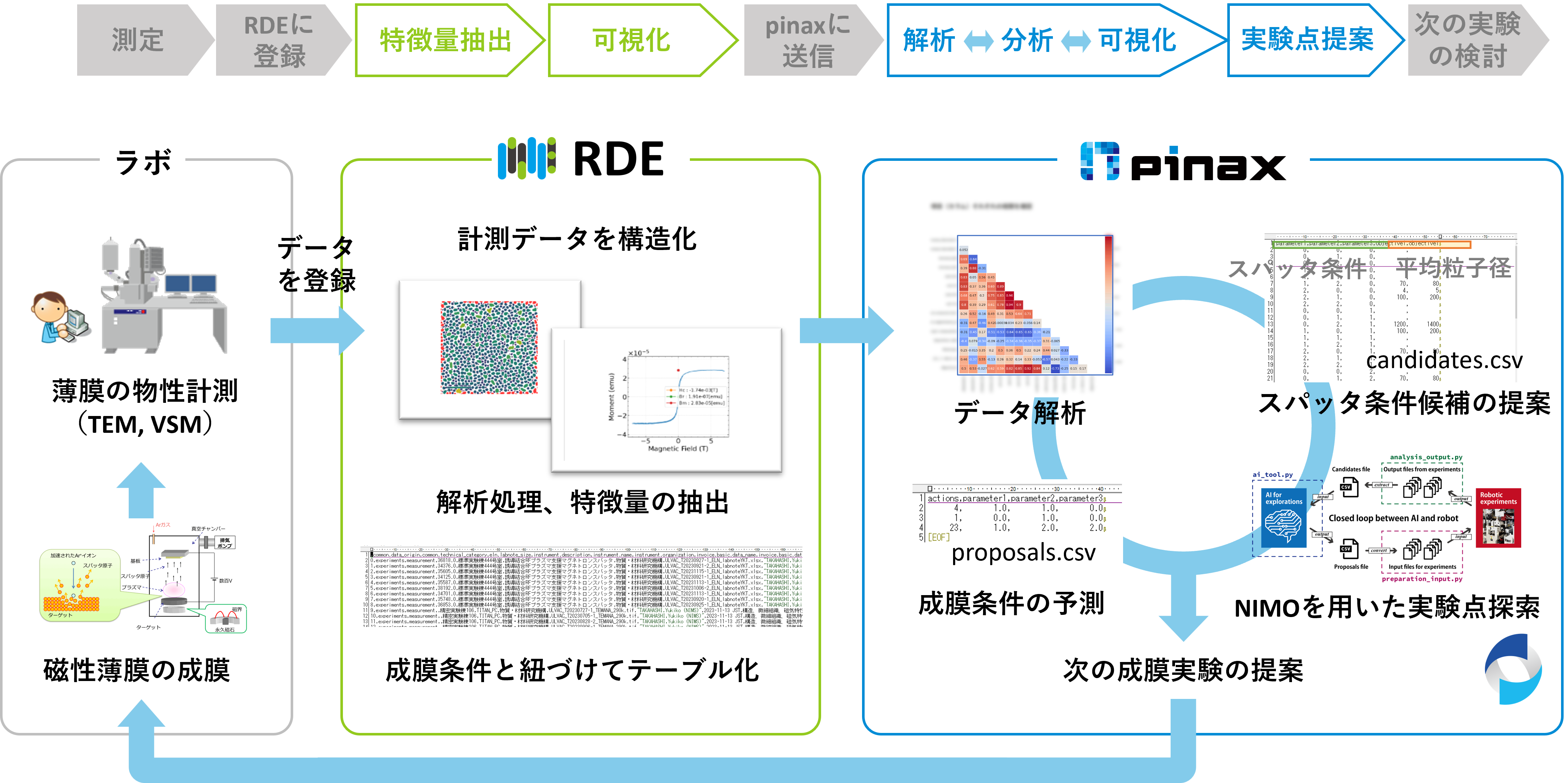
Figure 2: Overview of a research example integrating RDE and pinax

How to Use pinax (Guides)

  1. Getting Started Guide
  2. pinax Documentation (For registered users)

Get Started with pinax (Application Procedures)

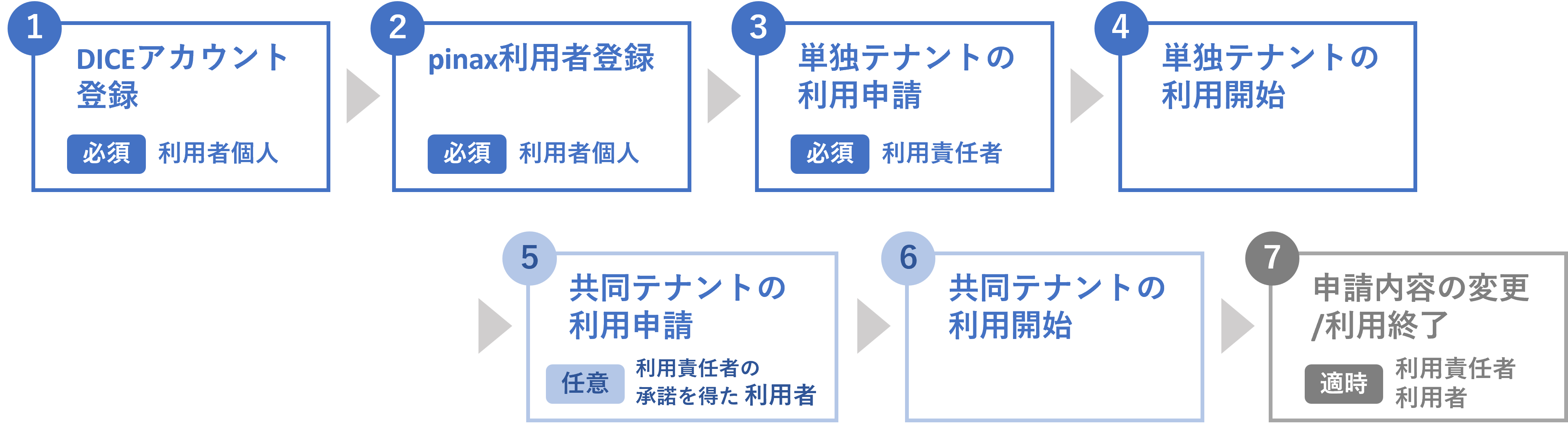
Steps to Start Using the Service


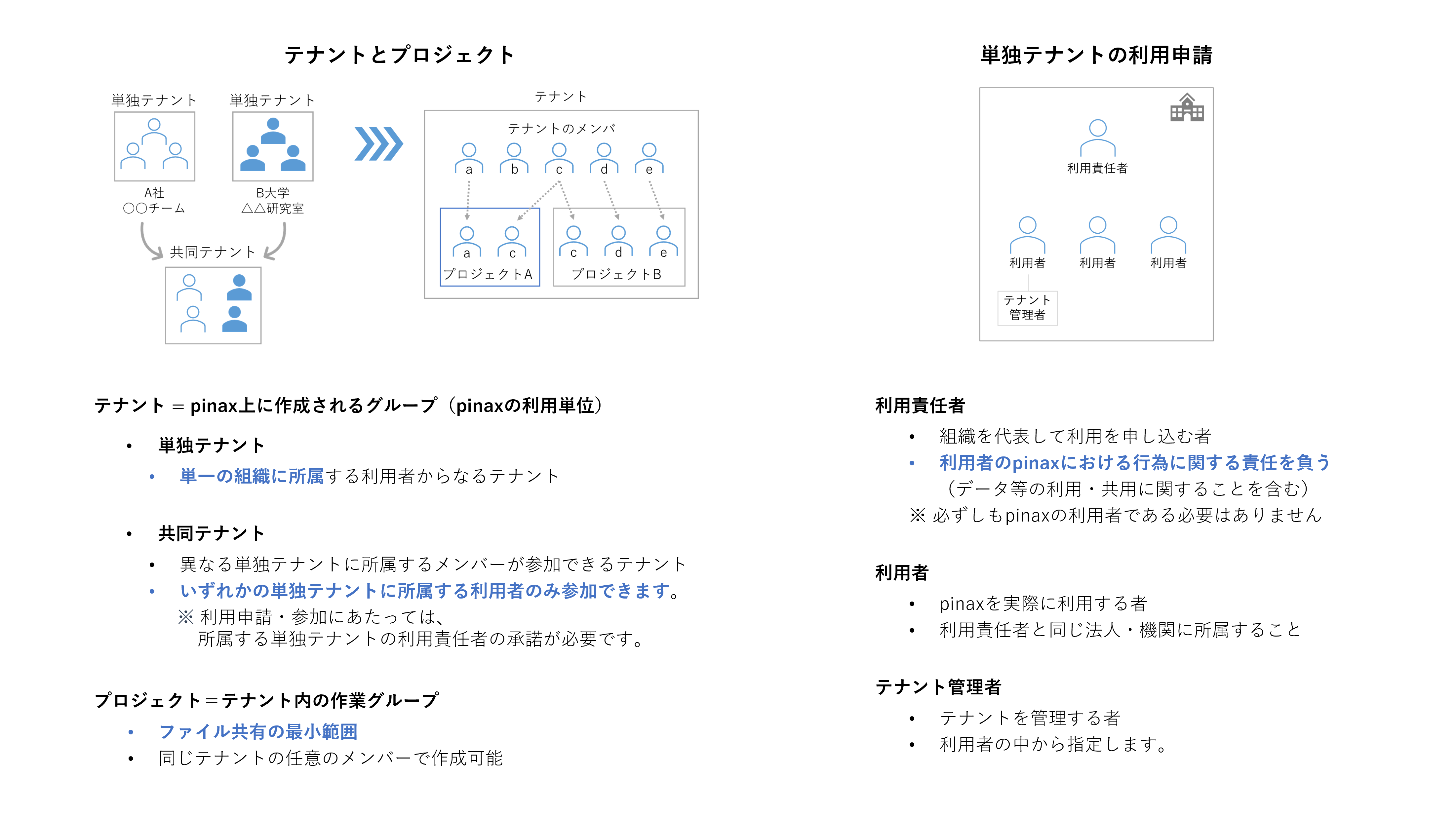
Note: A "tenant" in pinax is a group created on the system for its users. There are two types of tenants:
・Single Tenant: A tenant for users from a single organization.
・Collaborative Tenant: A tenant where users from different Single Tenants can participate and collaborate. Only users who already belong to a Single Tenant are eligible to join.

Details of Application Procedures
  1. DICE Account Registration [Required | Individual User]
  2. This account is required to use pinax.
    Please use the email address provided by your organization to complete "DICE Account User Registration".
    DICE Account Registration

  3. pinax User Registration [Required | Individual User]
  4. Please review the pinax Service Terms of Use and submit the "pinax User Registration Form".
    To register as a pinax user, you must meet two requirements:
    1. Be a person who satisfies the requirements of the Foreign Exchange and Foreign Trade Act.
    2. Belong to a Japanese corporation.
    pinax Service Terms of Use
    ・ pinax User Registration Form [Form]

  5. Single Tenant Usage Application [Required | Responsible Person]
  6. A responsible person from each institution applies for the use of a Single Tenant.
    After reviewing the pinax Service Terms of Use, please submit the "pinax Usage Application Form (Single Tenant)".
    pinax Service Terms of Use
    ・ pinax Application Form (Single Tenant) [Form] [Filling Instructions]

  7. Start Using a Single Tenant
  8. Once the application is approved, the responsible person will receive two emails (Usage Approval Notice and System Setup Completion Notice).
    Please follow the instructions in the System Setup Completion Notice to start using pinax.

  9. Collaborative Tenant Usage Application [Optional | User approved by the Responsible Person]
  10. If you wish to use a Collaborative Tenant, please obtain consent from the responsible person of your Single Tenant and then apply for usage.
    ・ pinax Application Form (Collaborative Tenant) [Form] [Filling Instructions]

  11. Start Using a Collaborative Tenant
  12. Once the application is approved, the responsible person will receive two emails (Usage Approval Notice and System Setup Completion Notice).

  13. Changing Application Details, Ending Usage [As Needed | Responsible Person, User]
  14. If you wish to change application details or end usage, please submit the required application form.
    Guidance on Various Procedures


  • Submit applications to: pinax=nims.go.jp (Please replace [ = ] with [ @ ])

If you have any questions or need clarification, please contact the pinax Support at pinax=nims.go.jp (Please replace [ = ] with [ @ ]).

System Requirements

Please use the latest version of a web browser (Google Chrome, Microsoft Edge, Firefox, Safari).

NEWS

NOTIFICATION

Scheduled system maintenance

Service may be unavailable every Wednesday from 18:00 to 20:00 (JST) due to scheduled system maintenance.

PAGE TOP